
Article: Food of the Gods: The 289-Year-Old Name Behind Your Toothpaste
Food of the Gods: The 289-Year-Old Name Behind Your Toothpaste
In 1737, in a glass hothouse on a Dutch estate near Haarlem, a young botanist bent over a cacao specimen and reached for a better name.
Carl Linnaeus was working at the Hartekamp, the garden of George Clifford, a wealthy Anglo-Dutch banker and director of the Dutch East India Company whose four heated greenhouses held plants from across the known world. Among them stood the cacao tree. Its old name, “Cacao,” Linnaeus set aside. In its place, in his book Hortus Cliffortianus, he wrote a new one: Theobroma, Greek for “food of the gods.”

What he actually wrote
We didn’t take anyone’s word for this. We went back to page 379 of the 1737 printing and read the genus entry as Linnaeus set it down.
He is blunt about the old name: Cacao nomen barbarum, “Cacao is a barbarous name.” Having rejected it, he explains the one he coined in its place. The tree deserved the name Theobroma, he writes, because its fruit is the basis of chocolate, a drink
“most delicious, most wholesome, most nourishing … once the preserve of European grandees alone.”

And then, in the middle of the Latin, he glosses his own invention in Greek: βρῶμα τῶν θεῶν (brōma tōn theōn), “food of the gods.” The etymology isn’t a later legend or a marketer’s flourish. It is right there on the page, in Linnaeus’s own gloss: θεός, god, plus βρῶμα, food.

He kept the older word, too: not discarded, but folded in as the species name. And so we know the tree today as Theobroma cacao, the divine name he chose joined to the ancient one he couldn’t quite let go.
One more detail from that entry, for the lovers of footnotes: Linnaeus complains that no one had ever properly drawn the cacao flower, and notes that his description rests on a dried specimen lent to him by the “illustrious” Hans Sloane, the great collector whose cabinet would later seed the British Museum. Even in 1737, this tree moved in distinguished company.

From a name to a molecule
A name is one thing. What came next is the part we love.
More than a century later, in 1841, the Russian chemist Alexander Woskresensky isolated a compound from the cacao bean and named it straight from Linnaeus’s genus: theobromine. (A quiet note for the curious: despite the “brom,” it contains no bromine at all; the root is the Greek brōma, “food,” not the element.)
That molecule is the heart of what we make. Theodent’s patented Rennou® technology is built on cacao-derived theobromine, the very compound whose name traces, link by link, back to a naturalist in a Dutch greenhouse who decided a plant deserved something grander. It’s why our toothpaste can be entirely fluoride-free. Nearly every other fluoride-free formula leans on nano-hydroxyapatite; we went back to the bean.
The gods, in your bathroom cabinet
There’s a pleasing symmetry to it. Chocolate began as a drink once reserved for grandees alone; Linnaeus himself notes it had already become common by his day, the way the best luxuries eventually do. The tree behind it was named for the divine. Nearly three centuries later, that lineage lives in something wonderfully ordinary: the tube by your sink, and the two minutes you spend with it each morning and night.
Not a bad heritage for a daily ritual: a 289-year-old act of naming, still quietly at work every time you brush.
Explore the Theodent collection and see what “food of the gods” feels like today.
Sources & further reading
- Linnaeus, C. (1737). Hortus Cliffortianus, p. 379, the entry that coins Theobroma. Biodiversity Heritage Library. The page images above are from the Missouri Botanical Garden copy in that collection; the transcription and translation are our own.
- Linnaeus, C. (1753). Species Plantarum, vol. 2, p. 782. Biodiversity Heritage Library.
- Woskresensky, A. (1842). “Ueber das Theobromin.” Justus Liebigs Annalen der Chemie und Pharmacie 41: 125–127. doi:10.1002/jlac.18420410117.
- U.S. Patent 9,610,235 B2, “Methods and compositions to improve mechanical resistance of teeth,” assigned to Theocorp Holding Co., LLC. Summary on our Science blog · Google Patents.
- Cuatrecasas, J. (1964). Cacao and Its Allies: A Taxonomic Revision of the Genus Theobroma. Contributions from the U.S. National Herbarium 35(6): 379–614. Smithsonian Research Online.
- “Phylogenetic evidence reshapes the taxonomy of Cacao and its allies (Theobroma and Herrania).” Brittonia 76 (2024): 53. doi:10.1007/s12228-024-09783-1.
- Cook, A. (2010). “Linnaeus and Chinese plants: a test of the linguistic imperialism thesis.” Notes and Records of the Royal Society 64(2): 121–138. doi:10.1098/rsnr.2009.0051.
- Lippi, D. (2013). “Chocolate in History: Food, Medicine, Medi-Food.” Nutrients 5(5): 1573–1584. doi:10.3390/nu5051573.
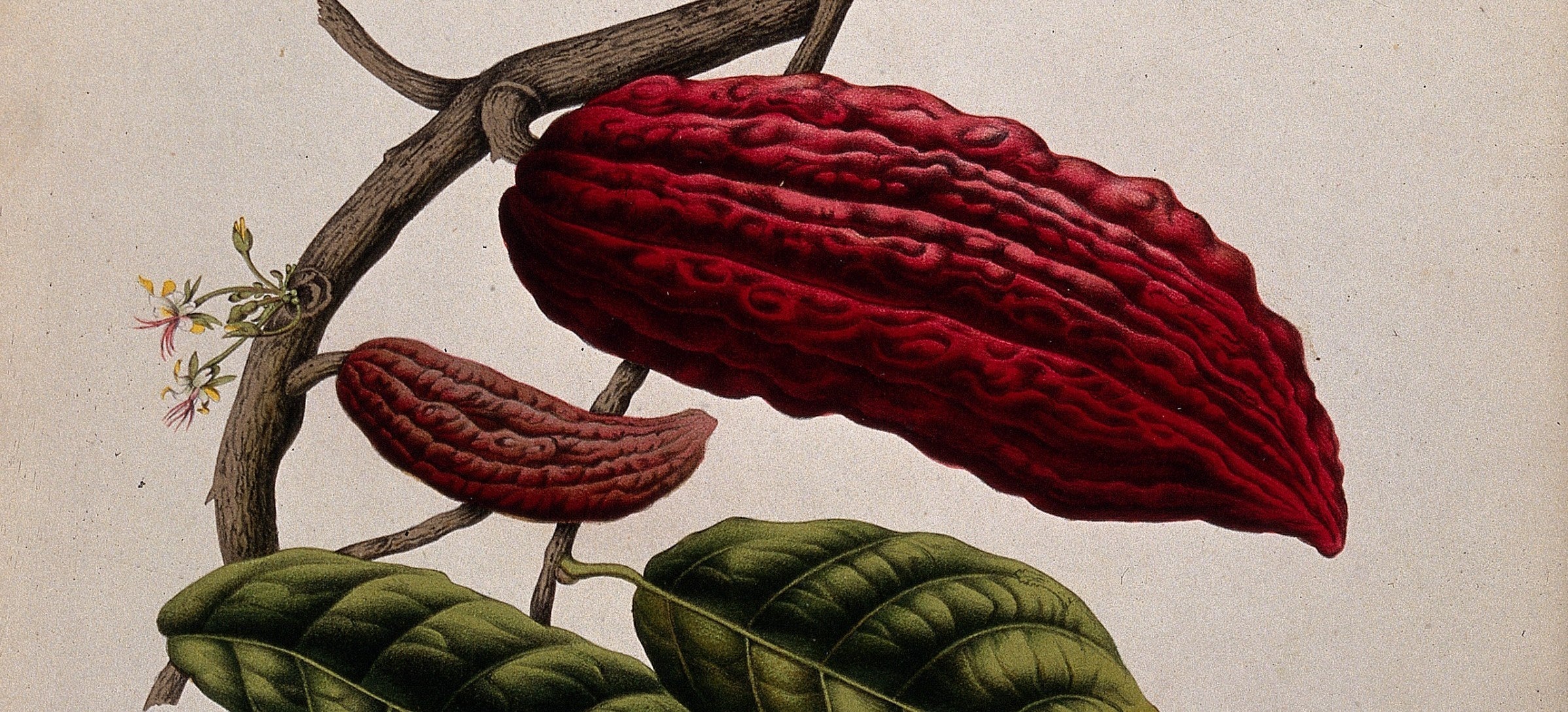
Banner: cacao branch with crimson pods, painted from nature by Berthe Hoola van Nooten for Fleurs, fruits et feuillages choisis de l’île de Java (c. 1880); public domain artwork, scan courtesy of the Wellcome Collection. Plate in text: Maria Sibylla Merian, Metamorphosis insectorum Surinamensium (1705), plate XXVI, public domain, via Wikimedia Commons; images served from our own library. Page images of Hortus Cliffortianus p. 379: Missouri Botanical Garden copy, digitized by the Biodiversity Heritage Library / Internet Archive.
